
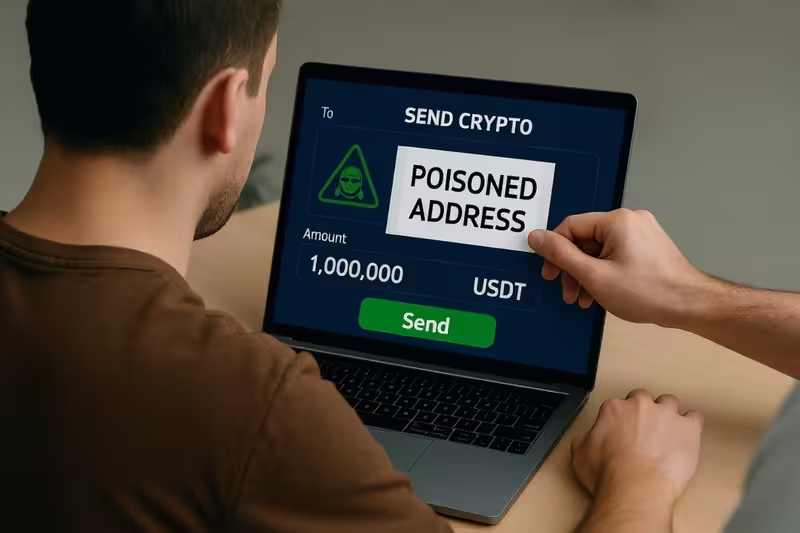
In today's digital world, cyber-attacks are no longer crude break-ins, they're meticulously designed psychological traps that exploit human habits. Among these, address poisoning attacks have emerged as particularly insidious. Far from relying on software vulnerabilities or malware, these scams manipulate transaction history and user behavior, weaponizing interface design and trust.
This blog explores one especially expensive, and ingenious, attack. Though the required resources may seem over-the-top, the approach underscores just how experimental and well-resourced modern attackers can be. You may already be familiar with this type of scam, but I want to highlight not only how it works but what one must prepare to pull it off.
Personal Anecdote: Even the Meticulous Can Be Tricked
I recently fell victim to such a scam. Even as someone who double-checks everything, I paused when I noticed something odd, but didn't pay enough attention.
Here's how it unfolded: an attacker had been monitoring my wallet and transaction patterns. They generated a look-alike address - one that started and ended similarly to my usual recipient, but misled with identical visual fragments in wallet explorers. They replicated my transactions right after mine, using stablecoin transfers, so both appeared in the same explorer in quick succession.
The attacker counted on me copying that fake address from the explorer and sending funds there. Simple, silent, yet devastating.
The Math Behind the Trick: Generating a Similar Address
The computational challenge behind generating a look-alike Ethereum address is far greater than it might seem at first glance. An Ethereum address is 40 hexadecimal characters long (20 bytes), but wallet interfaces typically display only the first and last ~8 characters, hiding the middle with an ellipsis. That means around 16 characters are visible, and for an attacker to convincingly spoof a destination address, those 16 must match exactly. The remaining 24 characters can be anything, but the visible portion has to line up perfectly. This is only achievable through brute-force address generation, also known as vanity address mining.
Now, let's work through the math. Each character in an Ethereum address is a hexadecimal digit, which means it can take on 16 possible values (0–f). Matching 16 characters requires:
1616 = 1.84 × 10¹⁹ possible combinations
That's 18 quintillion attempts before you'd expect to hit one match.
Suppose an attacker has a high-end GPU capable of roughly 109 (1 billion) hashes per second. In one day (86,400 seconds), that GPU could try:
109 × 86,400 = 8.64 × 10¹³ addresses
Now compare this to the search space:
1.84 × 10¹⁹ / 8.64 × 10¹³ ≈ 2.13 × 10⁵ days
That's about 584 years of nonstop computation on a single GPU.
So, it would take roughly 213,000 GPUs running in parallel for a full day just to brute-force a single address with matching 8+8 characters. For perspective, that's equivalent to the combined GPU count of several mid-sized data centers dedicated entirely to this one task.
And this estimate assumes everything runs perfectly efficiently, with no wasted cycles. In reality, performance would be hampered by factors such as memory bandwidth, synchronization delays, and power consumption, all of which make the effective throughput even lower. While attackers could in theory improve speed by moving away from GPUs and developing specialized ASICs tailored specifically for vanity address generation, the investment required to design, fabricate, and operate such chips at scale would be enormous. Building a cluster powerful enough to brute-force thousands of wallet targets would mean not just a handful of machines, but an industrial-grade operation likely costing tens to hundreds of millions of dollars in hardware development, facilities, and energy.
In other words, while the math shows it's technically possible, the resources needed make brute-forcing addresses an unrealistic strategy for average attackers. Only state-backed groups or large, well-funded criminal organizations could even consider such a project, and even then, the economics would only make sense if the potential payout was in the range of tens or hundreds of millions of dollars.
It is also important to consider the cost of sustaining this deception at scale. Seeding fake transactions across the Ethereum blockchain for even a single week is enormously expensive. If an attacker were to broadcast just 50,000 dust or zero-value “poisoning” transactions in a week, at an average gas fee of $0.50–$1.00 (a conservative estimate during periods of congestion), that's $25,000–$50,000 in gas fees every week just to keep the fake history alive. During spikes in gas prices, that figure could easily climb into the hundreds of thousands. At blockchain scale, the expenses become so high that only large, well-funded groups, often suspected to be state-backed, could sustain such operations for months at a time.
Why Am I a Target?
It's a natural question: why would anyone bother targeting me if my balances are modest and my transactions unremarkable compared to the setup costs I outlined?
The answer is that these attacks are not about singling out high-profile whales, they're about scale. Attackers cast extremely wide nets, scanning the entire Ethereum ecosystem for patterns of behavior. According to Chainalysis, wallets that regularly send funds to the same destination are prime candidates, because predictable transaction flows make it easier to insert a poisoned look-alike address into history. From the attacker's perspective, it doesn't matter whether the wallet holds a few hundred dollars or a few million—every transaction is an opportunity, and all it takes is one careless copy-and-paste to pay off.
This mass-targeting approach only works because attackers leverage enormous infrastructure. They rely on automation to track wallets in real time, GPU or ASIC clusters to generate convincing vanity addresses, and huge datasets to identify consistent senders. This isn't the work of a lone hacker in a garage - it's industrial-scale fraud. And that's precisely what makes it so dangerous: even ordinary users become targets, swept up simply because their transaction habits fit the attacker's playbook.
This highlights the true scale of the threat. The combination of brute-force address generation, massive infrastructure requirements, and ongoing costs for faking history points to organizations with significant financial and technical resources—not casual scammers. It's why so many researchers and security firms suspect that certain address poisoning campaigns are run by state-sponsored groups or highly organized criminal enterprises.
The Costliest Mistake: A $68 Million Loss in a Single Transaction
In May 2024, a cryptocurrency trader fell victim to an address poisoning scam that nearly resulted in a loss of $68 million in Wrapped Bitcoin (WBTC). The attacker had crafted a vanity address closely resembling the trader's, differing only slightly in the middle characters. Due to the way many wallet interfaces display addresses, showing only the first and last few characters, the trader failed to notice the subtle difference and inadvertently sent the substantial amount to the fraudulent address.
The attacker quickly moved the stolen WBTC to another address and subsequently returned the funds after a series of negotiations initiated by the victim. Despite the return, the scammer profited approximately $3 million due to the appreciation of Bitcoin during the period.
This incident underscores the sophistication and potential profitability of address poisoning attacks, highlighting the need for vigilance and enhanced security measures in cryptocurrency transactions.
The Takeaway: Why Even Ordinary Companies Are at Risk
This attack is a striking example of just how resourceful and experimental modern attackers have become. From sophisticated data analysis to industrial-scale address generation, these campaigns demonstrate both ingenuity and a willingness to take enormous risks for potential reward. The scale and audacity of such operations make it clear that any company, regardless of size or apparent risk profile, could become a target.
The only truly reliable countermeasure is to strengthen your defense perimeter to the maximum. This means not only securing technical infrastructure but also implementing operational processes and employee awareness programs that reduce the likelihood of human error. For more in-depth guidance, check out our article “Reinforcing Perimeter Defenses”, where we outline actionable steps to harden your organization against such threats.
Ultimately, the smartest move is to seek professional, qualified help. Security supervision services like ours are designed to protect your organization while letting your team focus on building products. By investing in expert audits, continuous monitoring, and training, companies can transform from easy targets into hardened, resilient operations.
Contrary to what some may assume, these services are not prohibitively expensive. In many cases, the cost is comparable to hiring a single senior developer, yet the potential return on investment is immense. For crypto companies handling sensitive digital assets, investing in professional security supervision can be the difference between smooth operations and a devastating breach.